Innovative solutions to stabilise the power grid
Primary: Stability grid
Secondary: Grid stability infrastructure solutions, What is grid stability, Renewable energy power grid
LSI: Grid services, Services grid, Grid connection solutions, Power grid stability

Keeping supply and demand in balance is the heart of grid stability. It means holding frequency and voltage within tight bands so homes, industries, and data centres get uninterrupted power. In practice, power grid stability depends on fast control, flexible capacity, and the ability to ride through outages, storms, and variable renewable output
Across APAC, solar and wind are growing fast. Midday solar peaks, evening demand surges, typhoons, and heat waves can pull the system in different directions. Storage and smart control help the stability grid absorb oversupply, fill evening peaks, and respond to sudden changes in seconds.
The building blocks of a resilient, stable grid
Short-duration storage for fast response
Lithium-ion BESS give system operators sub-second response that anchors primary frequency control, fast frequency response, and spinning reserve. In practice, that means the plant controller monitors grid frequency and voltage and dispatches power to arrest deviations before they cascade. These grid services also smooth ramps from solar clouds and evening load pickup on a renewable energy power grid.
Design choices that determine real-world impact:
Control stack. Combine droop control for frequency, automatic generation control participation for secondary response, and active power oscillation damping. This reduces wear while keeping the plant ready for the next event.
State of charge strategy. Hold headroom so the system can inject or absorb power at any time. Curtailed solar can be routed into the battery to maintain that headroom without new fuel cost.
Interconnection architecture. DC-coupled solar-plus-storage cuts conversion losses and can capture clipped energy. AC-coupled setups add siting flexibility and allow independent operation at substations that need local support.
When tuned well, short-duration storage reduces curtailment, improves ramping, and raises hosting capacity. Each effect contributes directly to power grid stability and to a more resilient stability grid.
Long-Duration Energy Storage for multi-day reliability
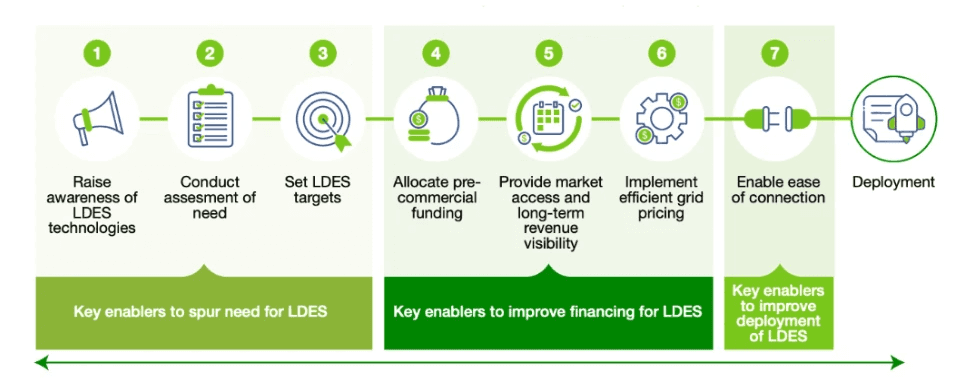
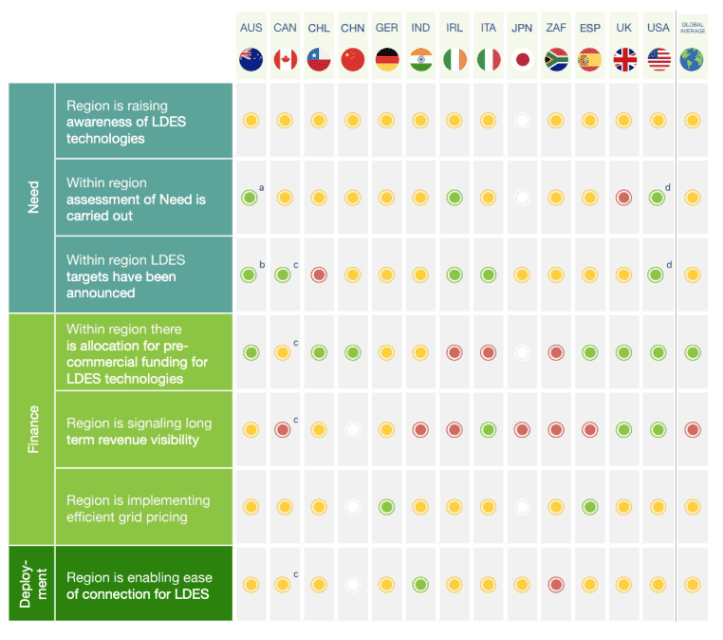
Short-duration systems cover seconds to a few hours. RE firming, round-the-clock baseload power and monsoon cloud cover, or low-wind periods require LDES. The LDES Council’s 2024 report explains how multi-hour to multi-day storage improves adequacy, reduces curtailment, and cuts total system cost when renewables dominate the stack, strengthening the stability grid.
How to think about LDES in planning
Use cases. Firming multi-day renewable dips, shifting surplus across days, contingency cover during transmission outages, and black-start support when paired with grid-forming controls
Portfolio fit. Pair LDES with lithium-ion. Lithium-ion handles fast events and short durationcycling. LDES ensures firm dispatchable renewable energy round-the-clock, and improves reliability metrics on a renewable energy power grid without oversizing peakers or wires.
Technology example. Iron-air uses a reversible rust reaction with iron, water, and air to store energy for 16 to up to 100 hours, which maps naturally to round-the-clock firming as well as catering to or prolonged cloud cover.
Done right, this is a cost-effective backbone for grid stability infrastructure solutions that target the exact gaps variable renewables leave behind.
Grid-forming inverters and synthetic inertia
As synchronous machines retire, inverter-based resources need to set voltage and frequency rather than simply follow them. Grid-forming inverters do this by establishing a stable reference and responding to disturbances like a “virtual machine.” Testing at Hornsdale in Australia shows grid-forming control can improve rate-of-change-of-frequency performance, provide synthetic inertia, and support system strength, which all benefit power grid stability.
Key capabilities to require in specs:
Virtual synchronous machine or grid-forming droop modes to stabilise weak grids and improve fault ride-through.
Black-start and islanding so batteries can re-energise sections after an outage and resynchronise safely.
Reactive power and voltage control to hold local profiles inside code, improving the surrounding stability grid during stressed conditions .
Smarter networks and grid connection solutions
Modern networks raise capacity with software, power electronics, and better sensing before reaching for new steel. This is where grid connection solutions earn their keep:
Dynamic voltage support. STATCOMs and advanced inverter VAR control stabilise weak nodes, reduce flicker, and maintain voltage during renewable swings. This keeps feeders within limits and lowers trips that undermine a renewable energy power grid.
Protection and settings. Adaptive protection and careful harmonic filtering allow higher inverter penetration without nuisance trips. Coordinated controls across BESS, solar, and STATCOMs prevent control conflicts and improve hosting capacity.
Thermal and transfer upgrades without rebuilds. Techniques like dynamic line rating and topology optimisation can increase usable transfer capacity. When paired with storage that shifts peaks and provides congestion relief, planners often defer substation upgrades and line reconductoring while still delivering measurable grid services on the services grid.
Together, these elements let operators buy and dispatch the exact capability they need, when they need it, which is the essence of a resilient stability grid.
Beyond storage - complementary grid stability infrastructure solutions for APAC
Forecasting, DERMS and orchestration
Better day-ahead to five-minute forecasting narrows the error bars on renewable output and load. That lets operators schedule charge windows for LDES and commit reserves with more confidence. A modern DERMS adds feeder-level visibility, constraint-aware dispatch, and setpoint control for rooftop PV, C&I storage and EV charging. Together, forecasting plus DERMS reduces the variability the stability grid must chase and raises the value of flexible assets on a renewable energy power grid.
What good looks like: unified telemetry from inverters and meters, locational limits baked into dispatch, and SOC policies that preserve headroom before forecasted ramps. That is how orchestration turns forecasts into dependable grid services rather than best-effort advice.
Demand response and virtual power plants
Well-designed demand response trims peaks, slows frequency excursions, and supports contingency recovery. Virtual power plants aggregate many small resources into a controllable portfolio that can deliver verified capacity and primary response. In APAC’s dense urban nodes, VPPs often relieve substation stress at the exact feeders that cause constraints. This improves power grid stability without new generation while creating measurable grid services revenue streams that coexist with LDES programs.
Design cue: contracts should specify telemetry granularity, response time, and availability windows so VPP events line up with system needs, not just price signals.
Grid-enhancing technologies at the interconnection
APAC networks have the potential to unlock transfer capacity before new lines are built. STATCOMs and SVCs keep voltage in range at weak nodes. Dynamic line rating raises thermal limits when conditions allow. Protection upgrades and advanced controls prevent nuisance trips at high inverter penetration. These targeted grid connection solutions smooth renewable flows and defer rebuilds while reinforcing the services grid that pays for demonstrable reliability outcomes.
Where it helps most: coastal wind corridors, solar-dense industrial belts, and corridors waiting on transmission upgrades. Pairing grid enhancing technologies with LDES lets planners shift energy into those windows when the corridor can carry more flow.
System strength and black start
System strength falls as synchronous plants retire. Two proven tools close the gap. Synchronous condensers supply fault current and inertia. Grid-forming controls on batteries or LDES set a stable voltage and frequency reference, ride through faults, and help re-energise lines step by step. Testing in Australia shows grid-forming operation improves rate-of-change-of-frequency performance and supports stable resynchronisation, which directly benefits the stability grid.
Operational takeaway: specify grid-forming modes, reactive power range, and black-start procedures in contracts so these services are available on call, not left as optional features.
Microgrids for islands and critical loads
Island systems, remote mines, data centres and hospitals across APAC gain resilience with microgrids that combine renewables, BESS and LDES under a single controller. During storms or long deficits, the microgrid islands smoothly, keeps priority loads running, and restores faster once the main network is back. Over the year, that same controller reduces diesel burn and curtailment, adding quiet, steady value to regional power grid stability (Source: pvcase.com).
Integration note: requires grid-forming operation, staged load pick-up, and clear interoperability with utility SCADA so microgrids support the wider renewable energy power grid during planned or unplanned islanding.
APAC in action - Projects that point the way
Singapore: Urban reliability at millisecond speed
EMA and Sembcorp’s Jurong Island ESS started at 285 MWh, providing millisecond response that cushions solar variability in a dense, land-constrained grid. In 2025, Sembcorp piloted vertical battery stacking at the same site to lift capacity to 326 MWh without expanding the footprint, a useful template for space-limited cities across APAC.
Australia: Grid-forming batteries as system tools
Hornsdale’s grid-forming upgrade shows batteries can supply synthetic inertia, improve rate-of-change-of-frequency and help keep interconnector limits stable. That combination directly improves power grid stability and creates new services pathways operators can procure alongside energy shifting.
Philippines: Portfolio approach at national scale
San Miguel Global Power is deploying about 1,000 MW of BESS across 32 locations to improve reliability on an islanded network. The spread of sites targets local constraints while building a services portfolio that supports a renewable-heavy stability grid.
Taiwan: Utility-owned storage to integrate rising renewables
Taipower’s 60 MW / 80 MWh Longtan system entered operation in 2024, part of a broader utility build-out that reached 160 MW of grid-scale storage that year. These assets support frequency control and local voltage, smoothing integration as the renewable energy power grid expands.
South Korea: Frequency regulation at fleet scale
KEPCO installed 376 MW of BESS for frequency regulation in earlier phases, demonstrating measurable power-quality benefits and operating-cost savings. The takeaway for planners is that targeted ancillary services can justify storage investment even before deep renewable penetration, strengthening the stability grid step by step.
India: Two complementary paths to reliability
India BESS (Kerala): SECI awarded 125 MW / 500 MWh to JSW Energy under a tariff-based model with viability-gap funding. The structure de-risks financing and puts storage into everyday operations, adding dependable evening and contingency cover that improves power grid stability.
India LDES (Karnataka): NTPC’s pilot will deploy Energy Dome’s CO₂ Battery at 160 MWh (20 MW, 8-hour) at Kudgi. This is a first-of-its-kind LDES demonstration in India aimed at multi-hour reliability and seasonal integration—useful evidence as APAC utilities evaluate firming options beyond daily cycling.
Why these projects matter for APAC planners
Across very different markets, the common pattern is clear: specify services, place assets where they solve real constraints, and prove impact with data. City-scale ESS (Singapore) reinforces an urban stability grid without extra land, grid-forming control (Australia) supplies system strength, distributed fleets (Philippines, Taiwan, South Korea) deliver local relief, and structured procurement (India) brings both BESS and LDES into standard operations. These are the building blocks for bankable grid stability infrastructure solutions across the region.
A practical roadmap for grid stability infrastructure solutions in APAC
Assess
Map frequency excursions, voltage weak spots, and congestion at substation and feeder level. Use these insights to place storage and grid connection solutions where they produce measurable reliability gains for the services grid.
Model
Right-size a mixed fleet. Use fast-response BESS for seconds to hours and LDES for RTC firming and multi-day gaps. Model monsoons, heat waves and typhoons so the stability grid has cover during rare but high-impact events.
Procure
Buy capabilities, not only hardware. Align RfPs with grid services outcomes like fast frequency response, primary response, dynamic voltage support and black start to strengthen the renewable energy power grid.
Operate
Dispatch storage first for reliability, then for arbitrage. Treat multi-day assets as insurance that holds the stability grid through prolonged wind or solar lulls.
MEINE Electric - iron-air LDES for APAC-ready stability grid performance
Why iron-air fits APAC needs
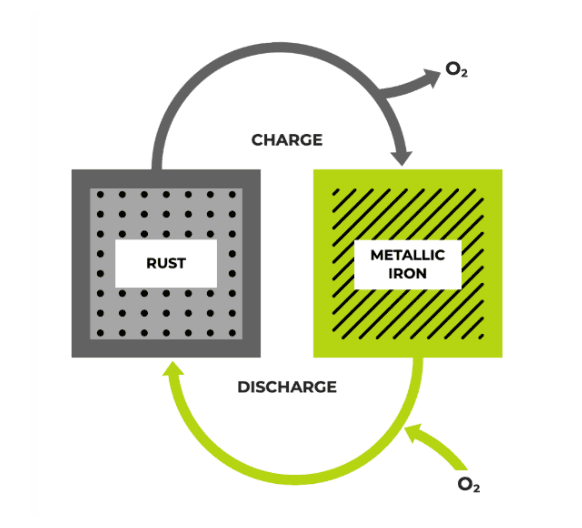
APAC grids faces energy curtailment during low demand hours and at the same time multi-day dips from typhoons, monsoon cloud cover, and heat-driven peaks near dense load pockets. Iron-air long-duration energy storage delivers ~16-100 hours of discharge using abundant, non-flammable materials, giving planners multi-day headroom while fitting urban and island sites on a renewable energy power grid. Because it complements daily-cycling batteries, iron-air strengthens portfolios that already provide fast response, closing the multi-day gap at the heart of what is grid stability on a high-renewables stability grid. MEINE targets scalable, affordable systems built for APAC climates and grid conditions.
How MEINE is solving for grid stabilisation
MEINE deploys daily cycling iron-air LDES batteries so operators can right-size for fast events and round-the-clock multi-day reliability on a stability grid. We size for 16-24hrs of cover, not just MWh, so firm energy spans forecast deficits, cutting curtailment on a renewable energy power grid. We align contracts and controls to measurable grid services, firm energy windows, primary response, local voltage support; matching how the services grid procures reliability. And we engineer clean node integration: plant reactive power plus substation devices keep long discharges within code; these grid connection solutions turn LDES into dependable capacity at weak or congested feeders, improving power grid stability without major rebuilds.
What this delivers
MEINE’s iron-air LDES provides 24x7 reliability, which reinforces the stability of the grid when short-duration batteries alone struggle. It reduces curtailment and makes more clean energy usable at the nodes that need it on a renewable energy power grid. Performance is verified with clear KPIs such as available energy at call, proven discharge duration and response time, so projects are bankable within broader grid stability infrastructure solutions and grid services markets.
If you are an IPP, EPC or an energy-intensive C&I buyer exploring multi-day storage, MEINE can help translate intermittent RE into firm RTC baseload power and integrate iron-air with existing assets and define service-level tests that keep the stability grid reliable through the longest gaps.
Learn more about our technology at meineelectric.com.