Impact of Iron–Air Batteries on Energy Transition and Decarbonization
Primary: Iron-air battery
Secondary: Iron-air battery technology, Iron-air battery efficiency
LSI: How does an iron-air battery work, Iron-air battery energy density

The world has a narrow window to keep global warming within 1.5–2 °C. That requires steep cuts in power sector emissions this decade, even as electricity demand rises and more industries electrify. Renewables are now the cheapest new source of power in many markets, yet grids still rely on coal and gas whenever the sun sets, the wind calms or demand spikes.
Global analysis by the Global Renewables Alliance suggests that energy storage capacity must grow roughly sixfold by 2030, to about 1.5 terawatts of storage, to stay aligned with net zero goals. Without enough storage, new solar and wind mostly displace fossil generation at midday, while coal and gas stay in place for evenings, nights and multi-day weather events.
Long Duration Energy Storage (LDES) is the missing piece that lets renewables replace fossil capacity hour after hour, day after day. Within this LDES landscape, the iron-air battery offers a way to store energy for several days using abundant, safe materials and to directly support deep power sector decarbonisation
The net zero challenge and the rise of the iron-air battery
Renewables are scaling fast. In 2024, the world added a record 580–740 gigawatts of renewable capacity, yet this is still not enough to hit the COP28 target of tripling global renewable capacity to around 11.2 terawatts by 2030 . As wind and solar grow, grids face two linked problems:
Periods of very low renewable output that last many hours or days.
Periods of oversupply, when clean electricity is simply wasted.
A recent report shows India curbing solar and wind output to keep the grid stable during low-demand periods. In Tamil Nadu, for example, grid curtailment wasted about 70 million units of renewable energy in a single week in May 2025, equal to roughly 8–10 million units per day . In Rajasthan, solar producers have reported curtailment reaching up to 48 per cent of output in some hours, with revenue losses above 26 million dollars since April 2025.
Every megawatt-hour curtailed is clean energy that does not displace coal or diesel. That slows decarbonisation, even when headline renewable capacity looks impressive.
This is where the iron-air battery enters the story. It is designed for upwards of 18 hours to even multi-day storage, not just for short-term evening peaks. By storing surplus renewable electricity when it is abundant and releasing it during no RE periods, iron air battery technology can cut curtailment and reduce the number of hours when fossil plants are still needed for reliability.
Why long-duration energy storage matters for deep decarbonisation
Most battery systems installed today, especially lithium-ion, are designed for 2–4 hours of discharge. They are excellent for peak shaving and short-term balancing, but they cannot cover a cloudy week or a long lull in wind.
Work by the Global Renewables Alliance and the LDES Council indicates that as power systems move towards more annual generation from wind and solar, they need a growing share of storage that can run between 8 and 100 hours.
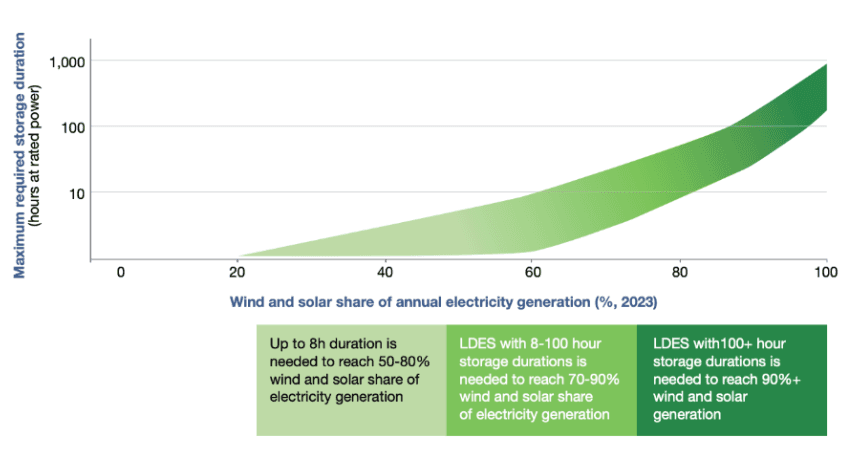
Without such LDES, grid operators keep large coal and gas fleets on standby. Even if those plants run fewer hours per year, they still lock in emissions, capacity payments and fuel infrastructure. Deep decarbonisation then becomes much harder.
Long-duration storage for 12+ hours, such as iron-air battery technology, helps in three important ways:
It turns surplus renewables into firm capacity rather than waste.
It allows coal and gas peaker plants to be retired or avoided.
It enables planners to design power systems where clean energy covers not just round-the-clock needs but also stress events and unusual weather patterns.
In this sense, the iron-air battery is not just another storage option. It is one of the tools that makes a mostly renewable, deeply decarbonised grid technically and economically feasible .
What makes an iron-air battery different from other storage technologies
Most conventional batteries store both reactants inside sealed cells. An iron-air battery works differently. It stores solid iron inside the system and uses oxygen from the surrounding air as the other reactant. That means only one main solid active material needs to be stored, which supports low material cost and simpler scaling.
In typical designs described in research and patents, the system has three main parts :
A negative electrode made of metallic iron or iron oxide.
A porous air electrode where oxygen from air participates in the reaction.
An aqueous electrolyte that carries ions between the two electrodes.
At the system level, Iron-air battery energy density is usually lower than lithium-ion, with practical values often in the range of roughly 50–60 Wh per kilogram today, and higher figures in advanced designs. That is acceptable for stationary grid storage, where volume and weight come second tocost, safety and duration.
Iron air battery technology focuses on delivering very low cost per kilowatt hour of energy capacity, multi-day duration and high safety, rather than chasing the highest possible Iron-air battery energy density the way electric vehicle batteries must do.
How does an iron-air battery work in practice?
The chemistry is often described as “reversible rusting”. This is a simple but accurate way to think about it.
So, how does an iron-air battery work step by step?
During discharge, iron in the battery reacts with oxygen from the air in the presence of the electrolyte. The iron oxidises, forming compounds such as iron hydroxide, and this oxidation releases electrons that flow through an external circuit as useful electrical power.
During charging, an external power source, such as surplus solar or wind, drives the reverse reaction. The iron compounds are converted back into metallic iron, and oxygen is released at the air electrode.
Form Energy’s widely discussed 100-hour projects in the United States use a similar reversible reaction between metallic iron and iron hydroxide to provide multi-day storage for the grid.
At a system scale, this simple “rust and derust” cycle allows iron air battery technology to be built from iron, air and water, which are abundant and familiar industrial materials, rather than constrained minerals like lithium, nickel or cobalt.
Iron air battery technology, performance and sustainability
One of the first questions people ask is about iron-air battery efficiency. Round-trip efficiency measures how much energy you get out compared to what you put in.
Several reviews and technical reports note that traditional aqueous iron-air systems often deliver round-trip iron-air battery efficiency in the range of about 40–60 per cent, depending on the exact design and operating conditions. Public information on commercial multi-day systems, such as those from Form Energy, also points to round-trip efficiencies below 50 per cent, but with very low cost per kilowatt hour of capacity.
By contrast, lithium-ion battery systems can often achieve 85–92 per cent round-trip efficiency in grid applications. Yet LDES studies show that for grid scale storage, cost per kilowatt hour and duration i.e energy capacity matter more for overall system economics than very high efficiency, especially in systems with frequent renewable oversupply.
On sustainability, iron air battery technology has several advantages highlighted in recent papers and reviews:
Iron is abundant, inexpensive and widely distributed.
Iron mining and processing use established supply chains, and steel is already one of the most recycled materials in the world.
Aqueous electrolytes reduce fire risk and avoid many of the safety issues associated with flammable organic solvents.
These attributes make the iron-air battery an attractive option for grid-scale storage that must expand to many terawatt hours while keeping its own material footprint, emissions and safety risks under control.
How the iron-air battery accelerates power sector decarbonisation
Decarbonisation is not only about installing more solar panels and wind turbines. It is about reducing the number of hours when coal and gas still supply the marginal unit of electricity. Long duration storage based on iron air battery technology helps change that balance in three ways:
Turning curtailment into carbon savings
When renewables are curtailed, coal and gas plants often continue to run during other hours. If an iron-air battery stores that surplus electricity and releases it later, it increases the share of total demand met by clean power and directly avoids fossil generation. In high renewable regions like Tamil Nadu or Rajasthan, each additional unit shifted in time can replace generation from coal plants that would otherwise ramp up during peaks or shortages.
Reducing the need for fossil peakers and backup
Planners keep peaking plants and backup diesel fleets as insurance against demandshortfalls. Iron air battery technology can provide the same reliability service with far lower emissions. Over time, this enables retirement of older fossil units and reduces the number of new thermal plants that must be built, which cuts long-lived emissions.
Linking grids with heavy industry
Academic work on “iron energy” concepts shows that reduced iron can serve as both an energy storage medium and a low-carbon input for steelmaking and other industrial processes. In the long term, a mature ecosystem around the iron-air battery could help connect power sector decarbonisation with industrial decarbonisation, rather than treating them as separate challenges.
System studies for high-renewable grids consistently find that adding long duration storage reduces total system cost and emissions compared to a combination of only short-duration storage and more renewable capacity. The iron-air battery sits at the heart of many of these scenarios as a practical, scalable way to deliver such storage.
Global momentum around iron air battery technology
The idea of iron-air batteries is not new, but the combination of climate pressure, cheap renewables and better materials has pushed the technology back into the spotlight.
Recent perspectives in ChemSusChem and other journals highlight iron-air systems as appealing, sustainable alternatives for grid-scale storage that can complement lithium-ion rather than replace it. Key developments include:
In the United States, Form Energy is building 100-hour iron-air projects with utilities and has received state and federal support for demonstration plants that aim to prove multi-day storage at very low cost per kilowatt hour.
In Europe, companies such as Ore Energy in the Netherlands have connected what is described as the world’s first grid-connected iron-air battery to support local renewable integration.
Research groups in Europe, North America and Asia are working on new chemistries, catalysts and solid-state variants that aim to push iron air battery efficiency toward 60–70 percent while raising Iron-air battery energy density and cycle life.
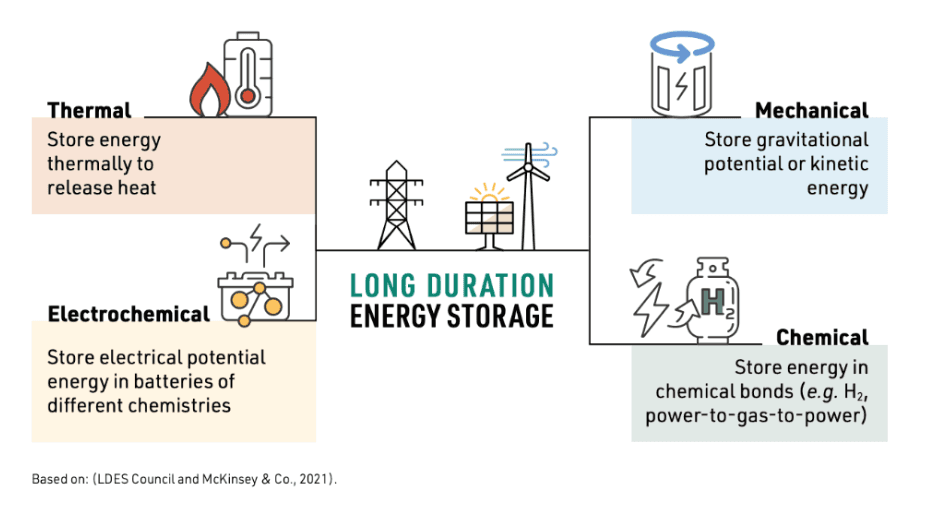
These moves sit within a broader push for LDES, where electrochemical options such as the iron-air battery complement mechanical, thermal and hydrogen-based storage solutions in different duration ranges.
What this means for India and APAC
India is emerging as one of the world’s most important renewable markets, with solar and wind capacity multiplying several times over the past decade. Yet the recent curtailment figures show that building generation capacity alone will not deliver deep decarbonisation.
Tamil Nadu’s grid curtailment of about 70 million units of renewable energy in one week, equal to 8–10 million units per day, signals that there is already more clean energy available at certain times than the grid can absorb.
In Rajasthan, reports of up to 48 percent curtailment during peak solar hours and losses of up to Rs 250 crore underline the economic cost of not having enough storage and transmission).
For India and other APAC markets with fast-growing demand and high renewable potential, iron air battery technology can support three strategic goals:
Higher renewable penetration without sacrificing grid stability.
Firm, low-carbon power for industry, commercial campuses and data centres.
Reduced dependence on imported coal and liquefied natural gas for balancing and backup.
These regions already have large iron and steel industries, which can eventually support local supply chains for iron-air battery materials. The use of water-based electrolytes and non-flammable, non-toxic reactants also suits densely populated cities and hot climates where safety, permitting and land use are major concerns.
MEINE Electric: APAC-rooted iron air battery technology for 16-24hrs storage
At MEINE Electric, we focus on one thing: turning intermittent renewables into reliable, round-the-clock power for India and APAC with multi-day iron-air battery storage. Our systems use a reversible “rusting–unrusting” reaction of iron in a water-based electrolyte to deliver dependable backup in the 16-24 hour range, tailored for RTC clean power.
We describe our solution as low-cost, RTCenergy storage built on iron-air batteries, because that combination matters for this region: abundant materials, long duration and a cost curve that can support mass deployment, not just pilots. Our iron air battery technology is engineered to bring the levelised cost of storage down to around 0.03 dollars per kilowatt hour at scale, roughly one tenth of typical lithium-ion solutions for similar durations. Ambitions at this cost level are aligned with global efforts to cut long-duration storage costs by up to 90 per cent by 2030.
In real projects, our iron air battery technology helps customers to:
Capture surplus solar and wind that would otherwise be curtailed and shift it across days.
Replace or sharply reduce reliance on diesel generators for industrial, commercial and community backup.
Add a clean resilience layer for operations that cannot accept any grid outages, face monsoon-driven variability and tariff volatility.
From a decarbonisation standpoint, our systems are designed to move the needle on emissions. Iron-air battery storage lets our customers use more of their renewable generation over nights and low-resource periods, cutting Scope 2 emissions from grid power. In many cases, it also reduces Scope 1 emissions by displacing on-site diesel backup. That links our technology directly to corporate climate targets, national clean-energy goals and better air quality across the region.
As long-duration storage scales up, our aim is clear: bring proven iron air battery technology into the heart of APAC’s power systems, so that curtailment, diesel backup and coal-heavy reliability give way to resilient, renewables-led grids.
If you are an IPP, EPC, or an energy-intensive C&I buyer exploring longer-duration storage for RTC energy, MEINE Electric can help turn demand risks into clear “reliable cover”, integrate iron-air battery systems with your existing renewable and grid assets, and define the performance and service-level tests needed to stay reliable through the longest gaps.
You can learn more about our technology and approach at meineelectric.com.