How Energy Storage Is Paving the Way for a Fossil Fuel-Free Future
Primary: energy storage system
Secondary: energy storage, battery energy storage system
LSI: battery energy storage,

The Energy Transition Challenge: Why Storage Sits At The Centre
Climate targets are tightening while electricity demand keeps rising. The International Renewable Energy Agency (IRENA) estimates that to stay aligned with a 1.5°C pathway, global renewable power capacity must roughly triple by 2030 and supply more than 90% of electricity by mid-century. At the same time, demand is surging across India, and the wider Asia–Pacific region as data centres, electrified transport and growing industries come online.
Much of this new capacity will be solar and wind. That is good news for emissions, but it creates a new problem for grid operators. Sunlight and wind are variable. In India and APAC, monsoon seasons, evening peaks and unplanned weather events can cause large swings in renewable output from one hour to the next.
Without a robust energy storage system, grid planners are forced to keep fossil fuel “peaker” plants on standby. These plants are expensive to run, exposed to fuel price volatility and add carbon back into what should be clean power.
Global agencies are clear that storage is not optional. The International Energy Agency (IEA) notes that batteries will need to scale up dramatically to support COP28 goals to triple renewables and double energy efficiency, and that batteries and smart charging will provide more than half of global short-term flexibility by 2050. IRENA also highlights that grids must add large amounts of flexible capacity, including storage, to integrate high shares of variable renewable energy and maintain reliability.
In short, the energy transition in India and APAC will succeed only if energy storage grows as fast as solar and wind.
Why Energy Storage Matters for a Fossil Fuel-Free Future
Fossil peaker plants were designed for a different era. They ramp up quickly to cover evening peaks or unexpected demand spikes. But they lock utilities into fuel costs and emissions for decades. As renewable penetration increases, running thermal plants only a few hours a year also becomes uneconomic.
A modern energy storage system tackles this challenge in three ways.
Daily Flexibility for Balancing Renewables
A battery energy storage system soaks up excess solar at midday and delivers it during the evening peak. This reduces curtailment and allows renewables to cover more of the daily demand curve.
Grid Stability and Fast Response
Fast-responding storage can provide frequency control, voltage support, and other grid-stabilising services far more quickly than gas turbines. The IEA emphasises that batteries are becoming a key source of secure capacity during hours of high demand and low renewable output
To move fully away from fossil fuels, grids also need technologies that can provide round-the-clock, reliable power, bridge multi-day periods of low wind and sun, or even seasonal mismatches. IRENA’s outlook points to an increasing need for long-duration storage to integrate high shares of renewable energy while retaining stability and affordability.
The Long Duration Energy Storage Council notes that 8–100-hour storage is essential as we move to increased renewables penetration.
India already experiences this tension. Reports highlight that grid constraints and curtailment have led to tens of millions of dollars in lost solar output in recent years, particularly in high-renewables states such as Tamil Nadu.
The conclusion is clear: short-duration lithium-ion and long-duration solutions, such as iron-air, together make it possible to build a fully fossil-fuel-free grid.

Today’s Energy Storage Landscape: Strong Growth, Short Durations
Over the past decade, lithium-ion has become the default battery energy storage system thanks to scale, falling costs and reliable performance.
MarketsandMarkets projects that the global battery energy storage system market will grow from about 50.81 billion USD in 2025 to 105.96 billion USD by 2030, with a CAGR of roughly 15.8%.
Even with this growth, Europe’s anticipated five-fold increase in battery storage capacity through 2030 is still seen as insufficient to fully balance renewables.
Most of these deployments offer one to four hours of storage. Ideal for daily shifting and grid services, but not enough for the round-the-clock renewable coverage or multi-day balancing needed for deep decarbonisation.
In India and APAC, curtailment and grid bottlenecks already reduce renewable utilisation, especially in solar and wind-heavy states. Meeting India’s 500 GW renewables target will require a major buildout of long-duration storage.
The opportunity is clear: lithium-ion will remain vital, but complementary long-duration solutions must rise alongside it.
Metal-Air and Iron-Air Batteries: The Future of Long-Duration Storage
Metal-air batteries use a metal anode and oxygen from the air as the cathode. Instead of storing both electrodes inside the cell, they “breathe” oxygen, which allows them to achieve very high theoretical energy densities. Metal-air chemistries, including lithium–air, sodium–air, magnesium–air, zinc–air and aluminium–air, have consistently shown energy densities far above those of conventional lithium-ion cells, which makes them attractive candidates for next-generation energy storage.
Why Metal-Air Batteries Stand Out
Within the metal-air family, iron-air batteries stand out for grid applications. Iron is abundant, low-cost, and widely available across India and APAC. Iron-air cells operate through a reversible rusting reaction. During discharge, metallic iron reacts with oxygen and water to form iron hydroxides, releasing electrons that power the device. During charging, the process reverses and the “rust” turns back into iron.
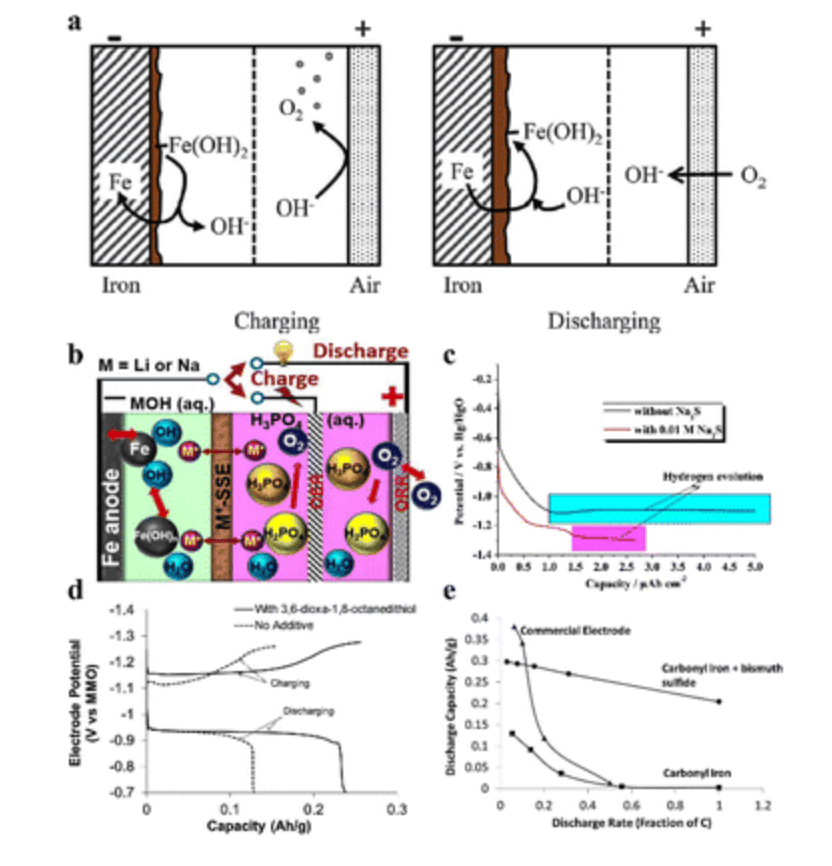
This mechanism offers several advantages for a long-duration energy storage system:
Low active material cost: Iron is significantly cheaper than lithium and does not rely on constrained metals like cobalt or nickel.
Inherent safety: Iron-air batteries typically use aqueous electrolytes and non-flammable materials, which reduces fire risk compared with many high-energy lithium-ion chemistries.
Suitability for multi-hour to multi-day durations: Iron-air technology trades some round-trip efficiency for very low cost per kilowatt-hour stored, which is ideal for 10–24 hour applications and beyond.
Industry reports on long-duration energy storage highlight technologies such as iron-air, flow batteries and thermal storage as key options for providing multi-hour to multi-day flexibility for deeply decarbonised grids.
The broader category of battery energy storage will likely remain a blend of chemistries. Lithium-ion dominates short durations. Alternative chemistries such as sodium-ion, zinc-air, flow batteries and thermal storage are emerging in specific niches. For India and APAC, iron-air’s ability to deliver affordable, safe, multi-day storage using local materials makes it a natural candidate to support a fossil fuel-free grid.
MEINE ELECTRIC’s Role in Enabling a Fossil Fuel-Free India and APAC
MEINE ELECTRIC was founded on a simple premise: intermittent renewables should deliver power as reliably as conventional plants. To do that, the company is developing an iron-air energy storage system tailored to India and the wider APAC region, where monsoon patterns, curtailment and industrial outages create a clear need for long-duration storage.
We aim to be one of APAC’s first dedicated iron-air long-duration storage players, offering 16-24-hour storage that works alongside existing lithium-ion assets rather than replacing them. The focus is on duration, cost, safety and ease of integration for IPPs, EPCs and utilities.
From a technical standpoint, MEINE’s iron-air platform is designed for:
16-24-hour storage today, with a possibility to expand to multi-day durations, to firm solar and wind across weather events.
Low-cost storage at scale, with internal projections targeting a levelised cost of storage of about 0.03 USD/kWh at maturity.
Safe, aqueous chemistry, using iron, water and air with a non-flammable electrolyte, to reduce fire and toxicity concerns seen in some conventional battery energy storage projects.
On the product side, MEINE is working on modular iron-air systems built around a 40 kW / 720 kWh skid designed to discharge over 18 hours (C/18) over a project life of 10 years. These skids can be combined into multi-megawatt or gigawatt-hour plants. A rapid progression from lab-scale cells to a 1kW module, backed by growing IP, is central to its “prove-first” approach for project developers.
MEINE frames iron-air as complementary to existing battery energy storage system deployments. Lithium-ion remains suited to fast, short-duration tasks; iron-air steps in for 16–24-hour support. Together, they can provide a more robust flexibility stack for APAC, in line with what IRENA says will be needed for net-zero-compatible power systems.
Looking Ahead: Powering a Renewable Future with MEINE ELECTRIC
Global analysis from the IEA and IRENA is clear: storage must scale rapidly if countries are to meet climate and reliability goals, and batteries will be one of the core tools for doing so. For India and APAC, this is already visible in growing solar, wind and hybrid capacity, alongside ongoing issues such as curtailment, grid congestion and exposure to fossil fuel price swings.
Short-duration battery energy storage helps manage peak demands, but it does not fully address the round-the-clock or multi-day energy needs. Iron-air long-duration storage can help close that gap by offering 16-18hours of backup at the least cost and with more abundant materials.
MEINE ELECTRIC’s role is to turn this into practical infrastructure. Its iron-air energy storage system is being developed to:
Turn curtailed or stranded renewables into firm, dispatchable power for utilities.
Help industrial customers manage outages and tariff volatility with on-site long-duration battery energy storage.
Support governments and grid operators in meeting clean-energy and reliability targets in a cost-conscious way.
As renewables grow across APAC, the combination of high-penetration solar and wind, flexible lithium-ion assets and scalable iron-air LDES will increasingly shape how power systems are planned. For developers, policymakers and businesses looking to move from intermittent to round-the-clock clean energy, it is now about how technologies like iron-air fit into project portfolios and grid plans, not whether they are needed.
MEINE ELECTRIC aims to be a practical partner in that shift, using long-duration iron-air storage to help India and the region translate climate targets into dependable, affordable clean power.
If you are an IPP, EPC, or an energy-intensive C&I customer exploring long-duration energy storage technologies, we would love to collaborate on pilot deployments that prove performance on real duty cycles.
Learn more about our technology: meineelectric.com