Future of Grid-Scale Storage
Primary: grid-scale battery storage
Secondary: grid-scale battery energy storage, grid-scale energy storage, grid-scale storage
LSI: long-duration energy storage, LDES, utility-scale storage, renewable firming

As power systems integrate higher shares of solar and wind, the role of grid-scale battery storage has fundamentally changed. What was once deployed mainly for peak shaving or ancillary services is now central to grid reliability, renewable integration, and long-term energy security.
By 2026, most utilities and grid planners agree on one point: renewables alone do not make a resilient grid. Storage is the system-level enabler that converts variable generation into dependable electricity. The future of power systems will therefore be shaped by how grid-scale energy storage evolves in duration, cost, and functionality.
Understanding Grid-Scale Storage in Modern Power Systems
What is grid-scale battery storage?
Grid-scale battery storage refers to large energy storage systems connected directly to transmission or distribution networks. These systems store electricity when supply exceeds demand and discharge it when the grid requires support. Unlike residential or commercial batteries, grid-scale assets operate as infrastructure, influencing frequency control, peak capacity, and overall system stability.
Most deployed grid-scale battery energy storage systems today are lithium-ion-based, typically designed for discharge durations of 2 to 4 hours. This configuration aligns well with peak shaving and fast-response services.
Why grid-scale energy storage matters now
Traditional power grids were built around controllable generation from coal, gas, and hydro. Solar and wind introduce variability that cannot be dispatched on demand. As renewable penetration increases, this variability leads to curtailment, price volatility, and reliability challenges.
Grid-scale energy storage directly addresses these issues by shifting excess generation to periods of demand, reducing curtailment and improving grid utilisation. Without storage, adding more renewables eventually strains grid operations rather than strengthening them.
Key Drivers Accelerating Grid-Scale Storage Adoption
Rising renewable penetration
Global renewable capacity additions continue to grow year over year. Market outlooks indicate that solar and wind will dominate new generation capacity additions through the late 2020s. This growth increases the need for grid-scale storage systems that can manage variability across hours and days, not just minutes.
Grid congestion and curtailment
In many regions, renewable generation is expanding faster than transmission infrastructure. This mismatch results in frequent curtailment during periods of low demand or grid congestion. Studies highlight that significant volumes of clean electricity are wasted due to the lack of flexible storage and transmission capacity.
Grid-scale battery storage allows this excess energy to be captured and redeployed, improving project economics and reducing system inefficiencies.
Policy and Regulation: Storage as Grid Infrastructure
Governments and regulators are increasingly treating grid-scale storage as essential infrastructure rather than a peripheral technology. Policy frameworks are evolving to support storage participation in energy, capacity, and ancillary service markets.
Several outlooks emphasise that long-duration grid-scale energy storage will be critical for maintaining reliability to meet a stable baseload and during extreme weather events and prolonged renewable shortfalls .
Changing market structures
Electricity markets are evolving to value flexibility alongside generation. Capacity markets, ancillary service revenues, and time-based pricing increasingly reward assets that can respond dynamically to grid needs. As a result, grid-scale battery energy storage is becoming a revenue-generating grid asset rather than a cost centre.
Limits of Short-Duration Grid-Scale Battery Energy Storage
The four-hour ceiling
Lithium-ion has become the default choice for grid-scale battery storage due to declining costs and proven performance. However, most systems are optimised for short discharge durations. While effective for frequency regulation and peak shaving, they struggle to address longer gaps in renewable generation.
As grids move beyond 30-40% renewable penetration, short-duration storage alone cannot ensure reliability. Evening demand peaks, overnight lulls in solar output, and prolonged weather-driven events expose the limits of four-hour systems.
Economic constraints
Extending lithium-ion systems to longer durations requires proportionally more battery packs, increasing capital costs, material intensity, and safety management requirements. These trade-offs are prompting planners to evaluate alternative approaches to grid-scale energy storage that can deliver longer discharge durations with more stable lifecycle economics.
The Shift Toward Long-Duration Grid-Scale Storage
Defining long-duration energy storage
Long-duration energy storage typically refers to systems capable of delivering power for eight hours or more as per the LDES Council. Some technologies target multi-day or seasonal storage. Within the broader grid-scale storage landscape, long-duration systems serve a distinct purpose by addressing extended mismatches between generation and demand.
Why LDES is gaining traction
Analysts increasingly agree that high-renewable grids require a mix of storage durations. Short-duration assets manage rapid fluctuations, while long-duration systems sustain power through extended deficits. This layered approach reduces reliance on fossil backup and improves system resilience.
Technologies Shaping the Future of Grid-Scale Storage
Grid-forming and hybrid systems
Future grid-scale battery storage systems are expected to play an active role in grid stability. Grid-forming inverters allow storage assets to establish voltage and frequency, particularly important in inverter-dominated grids. Hybrid configurations combining multiple storage technologies are also gaining attention for their ability to serve different grid functions simultaneously .
Alternative battery chemistries
Beyond lithium-ion, several chemistries are being explored for grid-scale energy storage, including sodium-ion, flow batteries, and metal-air systems. These technologies often prioritise lower material costs, longer lifetimes, and improved safety over high energy density.
Metal-air batteries are particularly relevant for long-duration applications due to their reliance on abundant materials and ability to deliver extended discharge at a lower cost per stored kilowatt-hour.
Market Outlook for Grid-Scale Battery Storage
Growth trajectory
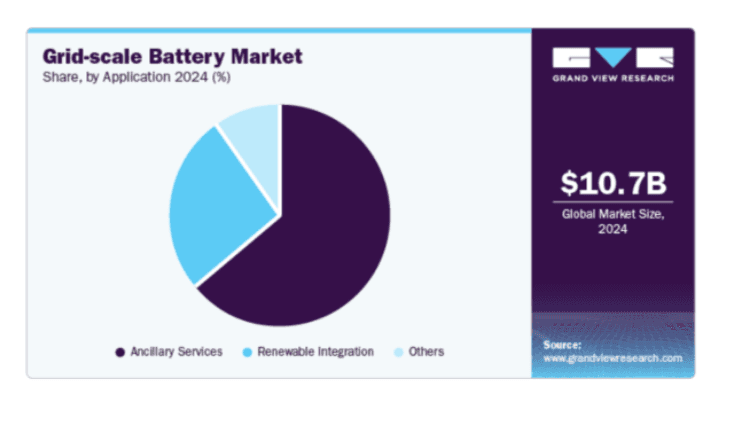
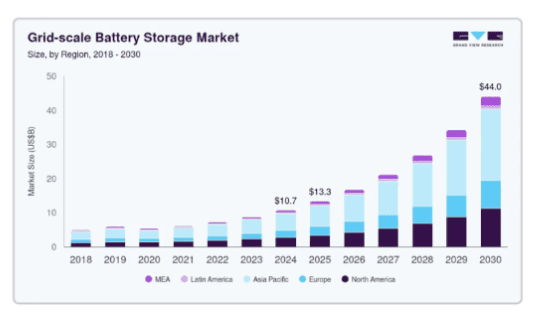
Market research indicates strong growth for grid-scale battery storage through 2030 and beyond, driven by renewable integration and grid modernisation efforts. Installed capacity is expected to expand at double-digit annual growth rates across major markets.
Regional trends
While North America and Europe currently lead in deployments, Asia-Pacific is projected to become the fastest-growing region for grid-scale battery energy storage. Rapid renewable expansion, rising electricity demand, and grid constraints are accelerating adoption across the region.
From Information to Impact: Where Meine Electric Fits In
Why long-duration storage matters for emerging grids
As renewable penetration rises in fast-growing markets, the limitations of short-duration systems become increasingly visible. Grids facing seasonal variability, transmission bottlenecks, and curtailment require storage that can operate reliably for extended periods without costs scaling linearly with duration. Long-duration grid-scale energy storage is no longer optional. It is a structural requirement for converting renewable capacity into firm power.
Meine Electric’s approach to grid-scale storage
Meine Electric is developing iron-air battery systems designed for long-duration, utility-scale deployment. These systems use abundant, non-flammable materials such as iron, water, and air, aligning with the operational needs of large grid-connected projects.
MEINE Electric’s approach is to complement existing grid-scale battery storage deployments rather than replacing them. Short-duration grid-scale battery energy storage continues to serve fast-response and intraday needs, while long-duration grid-scale storage addresses extended renewable gaps and firm capacity requirements. This stacked approach reflects how future grids are increasingly being planned.
If you are an IPP, EPC, or an energy-intensive C&I customer exploring long-duration energy storage technologies, we would love to collaborate on pilot deployments that prove performance on real duty cycles.
Learn more about our technology: meineelectric.com