The Environmental Benefits of Metal Batteries Compared to Lithium-Ion
Primary: lithium-ion battery explosion
Secondary: lithium-ion batteries, lithium batteries
LSI: Nickel metal hydride batteries, charging nickel metal hydride batteries, battery metals, metal-detector batteries

When people search for lithium-ion battery explosions, they’re usually thinking about safety. But there’s a bigger environmental story behind that fear: what we mine, how far materials travel, what happens when packs fail, and how hard they are to recover at the end of life.
Here, we’ll compare today’s dominant lithium-ion batteries with a wider family of “metal batteries” (including metal-air and other metal-based chemistries) through an environmental lens. The goal is not to “replace” one technology with another. It’s to understand where each fits, and why long-duration energy storage (LDES) is changing what “better for the planet” looks like.
What “metal batteries” actually mean (and what it doesn’t)
“Metal batteries” is a broad label. In practice, it often refers to chemistries where a metal is the main active material at the anode, and where the design may reduce dependence on scarce or geopolitically complex battery metals like cobalt and nickel.
Metal-air batteries (like iron-air) vs other metal-based batteries
Two categories show up most in real-world conversations:
Metal-air batteries (iron-air, zinc-air, aluminium-air, and others)
These typically use oxygen from the air as a reactant. That can reduce material intensity because one “ingredient” is pulled from the atmosphere rather than carried inside the cell.
Other metal-based rechargeable batteries (like nickel metal hydride batteries)
These have existed for decades and are common in consumer formats (like AA rechargeables) and some industrial applications. They are not “LDES batteries,” but they are important when discussing safe household use and waste streams.
The environmental footprint of lithium-ion batteries across their lifecycle
Most climate and sustainability discussions focus on “use-phase emissions.” Batteries are different. Their biggest environmental impacts often sit upstream (mining, refining, manufacturing) and downstream (waste, safety incidents, recycling infrastructure).
Mining and refining concentrates impact on a few materials and regions
Modern lithium-ion batteries rely on a mix of critical minerals and industrial materials such as cobalt, graphite, and lithium, which are considered critical minerals.
That matters environmentally because critical minerals are frequently associated with:
high-energy refining steps,
long transport routes,
local water and land impacts.
You don’t need to claim that all mining is “bad” to recognise the risk: when a clean-energy supply chain depends heavily on a narrow set of minerals and geographies, sustainability becomes fragile.
Transport distances can be surprisingly large
A Stanford lifecycle analysis highlighted how globalised this chain is. For conventional mining and refining of the active metals in a battery, the study estimated average transport distances of about 35,000 miles (57,000 km). For a recycling-to-refining pathway (in their U.S. scenario), the study estimated about 140 miles (225 km).
That gap isn’t just a logistics detail. It translates into real energy use, emissions, and exposure to disruption.
End-of-life is improving, but it’s still a bottleneck
Recycling is often presented as the fix for the environmental footprint of Lithium batteries. It helps, but only if the collection, safe handling, and processing scale up fast enough.
The U.S. EPA explicitly frames recycling as a more sustainable approach than disposal because it conserves critical minerals and valuable materials.
Meanwhile, market forecasts suggest recycling capacity and investment are accelerating. One industry forecast estimates the lithium-ion battery recycling market at USD 7.2B in 2024, projecting USD 47B by 2034.
Why Lithium-Ion Battery Explosion Risk Has an Environmental Cost
A single lithium-ion battery explosion incident can turn an otherwise recyclable product into contaminated waste, create toxic smoke concerns, and disrupt collection systems (because recyclers and waste handlers become more cautious).
The NFPA notes that the likelihood of lithium-ion batteries overheating, catching fire, and even leading to explosions increases when batteries are damaged or improperly used, charged, or stored.
UL adds detail on what makes thermal runaway unique: it can generate extreme heat, fire, and violent venting, including the ejection of gas and debris, with hazards from smoke and vent gases.
This is the part that’s often missed in sustainability debates: safety affects waste. If consumers are afraid to return Lithium batteries, or if systems don’t provide safe collection, more packs end up in the wrong places.
Where metal batteries can reduce environmental impact
Metal batteries aren’t magically impact-free. They still involve manufacturing, materials, and end-of-life planning. Their environmental advantage is usually structural: fewer constrained materials, potentially simpler recovery, and in some designs, lower fire risk.
Abundant materials can ease supply-chain pressure
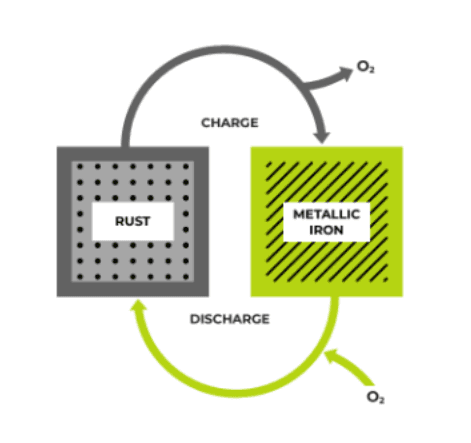
Iron-air batteries, for example, use iron, air, and water as core inputs in the chemistry described by multiple grid-scale developers.
The cathode uses widely available plastics and carbons, which have proven recyclability, eliminating hazardous waste concerns typical to other battery chemistries. In addition, the KOH-based electrolyte used has a proven disposal methodology through neutralisation.
When the active material is abundant and widely available, it can reduce the intensity of extraction pressure on constrained battery metals and make localisation easier over time. That’s not a guarantee, but it’s a meaningful design direction.
Lower fire risk can reduce downstream environmental harm
Some iron-air system descriptions emphasise inherently safer chemistry for grid deployments. A regional grid operator presentation describing iron-air systems highlights an “inherently safe chemistry,” positioned as complementary to Li-ion for reliability needs over longer stress periods.
That “complementary” framing matters. Lithium-ion batteries are great at fast response and shorter durations. But for longer durations and multi-day coverage, the engineering and safety requirements can change, and so can the environmental calculus.
Longer-duration storage can avoid fossil backup in a different way
Short-duration batteries mainly shave peaks and firm ramps. Multi-day storage can target a different emissions problem: keeping the grid stable through prolonged renewable lulls without defaulting to fossil peaker plants.
This is one reason iron-air has attracted attention as a 100-hour class technology.
Recycling: the biggest near-term lever for lithium-ion batteries, and a design opportunity for metal batteries
If you want one concrete, evidence-backed takeaway, it’s this: recycling is not a side quest. It is where a lot of the next decade’s sustainability gains will come from.
A Stanford lifecycle analysis found that, compared with mining and processing new metals, the studied Li-ion recycling pathway:
emitted 58% to 81% less greenhouse gases,
used 72% to 88% less water,
and used 77% to 89% less energy.
This does not mean every recycling facility is automatically cleaner. Stanford also notes that location and electricity mix can change results meaningfully.
For metal batteries, the recycling story is still being written at scale. But the lesson carries over: design choices that simplify disassembly, reduce hazardous materials, and improve recovery pathways will shape the real environmental outcome.
Practical Tips for Nickel Metal Hydride Batteries and Metal-Detector Batteries
Environmental benefit is not only about chemical choice. It’s also about correct use and correct end-of-life.
If you’re choosing batteries for household devices, nickel metal hydride batteries can be a practical alternative to single-use cells in many cases. And if you’re charging nickel metal hydride batteries, use the correct charger and avoid damaged cells, because misuse increases failure risk in any battery family.
For niche gear like metal detector batteries, the sustainable move is usually simple: use a rechargeable format when feasible and return end-of-life packs through a proper collection pathway, not the trash.
For grids and large assets, the “right battery” is usually a portfolio decision:
Lithium-ion batteries for fast response and shorter duration needs,
long-duration systems for multi-hour to multi-day firming,
and recycling plans that are designed at procurement, not added later.
What MEINE Electric Is Building with Metal Batteries for Grid-Scale Storage
Metal batteries are especially compelling in LDES because the problem is not energy density. It’s cost, safety, and supply-chain realism at massive scale.
MEINE Electric’s technology narrative focuses on an iron-air “reversible rust battery” that uses the natural iron-to-rust reaction to discharge, and a proprietary charging method to reverse that reaction, repeating the cycle many times.
MEINE also positions iron-air as a complement to lithium-ion batteries to “complete the energy stack” for utilities and industry, with a focus on affordable, long-duration storage for APAC grid conditions.
The cleanest battery is the one that fits the job without forcing waste, overspec, or fragile supply chains. Lithium-ion batteries are essential for many applications. Metal batteries, especially iron-air for LDES, can expand what’s possible with lower material stress and potentially lower risk profiles, while recycling scales up to close the loop.
If you are an IPP, EPC, or an energy-intensive C&I customer exploring long-duration energy storage technologies, we would love to collaborate on pilot and commercial deployments that prove performance on real duty cycles.
Learn more about our technology: meineelectric.com