What Is an Energy Storage System?
Primary: battery energy storage system
Secondary: power storage batteries

As renewable energy adoption accelerates worldwide, electricity systems are facing a structural challenge. Solar and wind power are clean and scalable, but they are also variable. Electricity demand does not always align with when renewable energy is generated. This mismatch creates instability, curtailment, and reliability concerns across power systems.
An Energy Storage System (ESS) exists to solve this problem. It allows electricity to be stored when supply exceeds demand and used later when energy is required. At the centre of modern deployments is the battery energy storage system, which has become essential for grid stability, renewable integration, and energy resilience in India and across the Asia-Pacific region.
This article explains what an Energy Storage System is, how it works, the types of technologies involved, and why long-duration storage is becoming critical for the future of clean energy.
What Is an Energy Storage System (ESS)?
An Energy Storage System is a technology that captures energy at one point in time and stores it for later use. In electricity networks, ESS is primarily used to balance supply and demand, smooth renewable variability, and maintain grid reliability.
Energy storage systems can be deployed at multiple levels:
Utility-scale grids
Commercial and industrial facilities
Microgrids and remote installations
While energy can be stored mechanically or thermally, modern power systems increasingly rely on battery energy storage systems due to their fast response times, modular design, and flexibility. India’s Ministry of New and Renewable Energy identifies energy storage as a key enabler for large-scale renewable integration and grid reliability.
How Does a Battery Energy Storage System Work?
A battery energy storage system acts as a controllable interface between electricity generation and consumption. Unlike traditional power plants, it does not generate electricity. Instead, it absorbs, stores, and dispatches energy based on grid conditions or end-user needs.
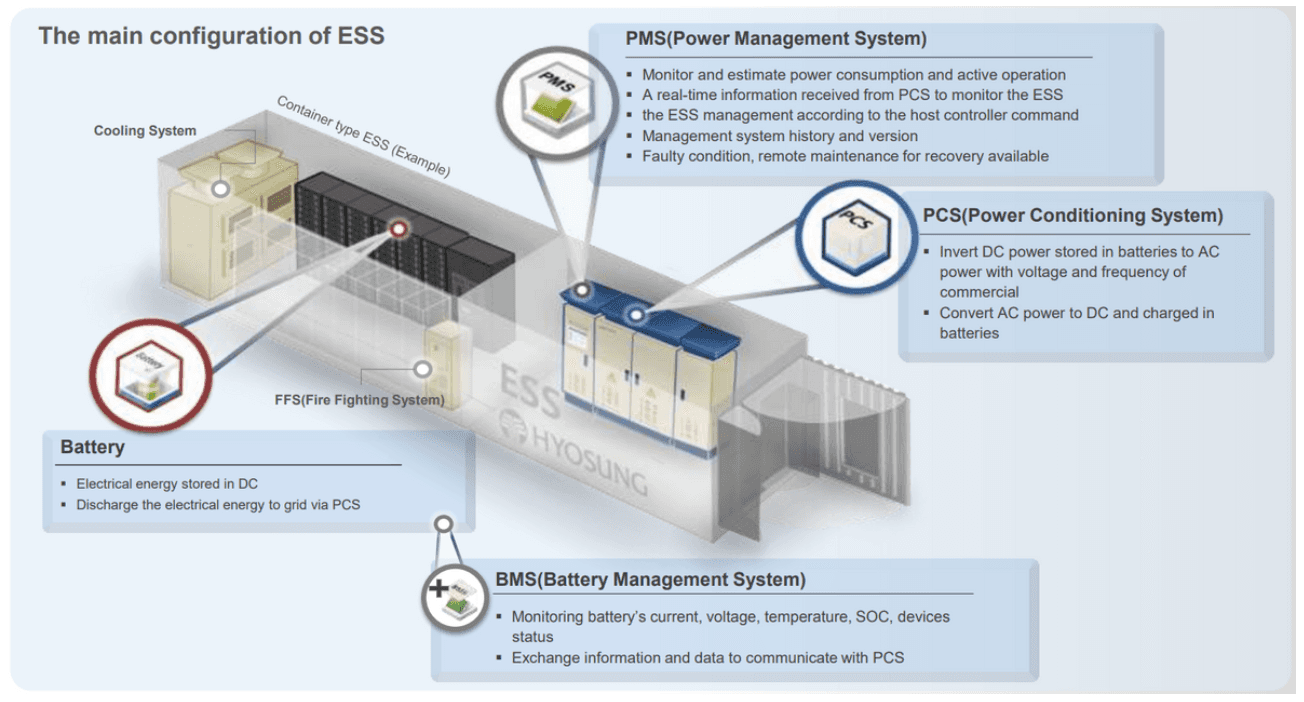
At a system level, a battery energy storage system integrates electrochemical storage, power electronics, thermal management, and software controls. This allows it to respond within milliseconds for grid services or operate steadily over several hours, depending on its design.
Charging
Charging occurs when the electricity supply exceeds demand or when electricity prices are low. Common charging windows include midday solar peaks, high wind generation periods, and low-demand grid conditions.
During charging, alternating current from the grid or a renewable source is converted into direct current by the Power Conversion System. This DC power drives electrochemical reactions inside the battery cells, storing energy in chemical form. Charging rates are actively managed to maximise efficiency, maintain safety, and reduce degradation.
In utility-scale battery energy storage projects, charging decisions are increasingly optimised using forecasts for renewable generation, grid congestion, and electricity prices rather than fixed schedules.
Storage
The storage phase determines how useful a battery energy storage system is for a given application. Energy can remain stored for minutes, hours, or longer, depending on system design and battery chemistry.
Short-duration lithium-ion systems are optimised for frequent cycling and high power output. However, as storage duration increases, costs and degradation risks rise. This makes storage duration a critical economic variable rather than a simple capacity metric.
Energy losses during storage are minimised through insulation, thermal management systems, and software controls. Even so, no storage system is entirely lossless, and efficiency varies across technologies.
Discharge
Discharge occurs when electricity demand exceeds supply or when stored energy delivers operational or economic value. The Power Conversion System converts DC electricity back into AC power synchronised with grid voltage and frequency.
A battery energy storage system can discharge energy for multiple purposes, including peak demand management, renewable firming, backup power, and grid stabilisation services. Unlike conventional generators, battery systems can ramp output almost instantly, making them highly effective in managing grid volatility.
Why Energy Storage Systems Are Becoming Essential
Energy storage systems are no longer optional assets. They are becoming foundational infrastructure as electricity grids transition toward higher shares of renewable energy.
Rising Renewable Energy Penetration
Solar and wind generation are inherently variable. Without storage, excess renewable generation must be curtailed when demand is low or transmission capacity is constrained. India has already experienced large-scale renewable curtailment due to grid congestion and demand mismatch. By capturing surplus electricity, battery energy storage systems directly improve renewable utilisation and project economics.
Grid Stability and Reliability
Historically, grid stability was provided by large thermal power plants. As these assets retire, grids increasingly depend on fast-responding technologies.
Battery energy storage provides frequency regulation, voltage support, reserve capacity, and black-start capability without fuel consumption or emissions. These attributes make battery energy storage a critical replacement for conventional grid-stabilising assets.
Energy Security and Cost Optimisation
Energy storage allows electricity to be shifted across time, reducing reliance on expensive peaking plants and imported fuels. Utilities and industries use power storage batteries to lower peak tariffs, reduce diesel generator usage, and improve resilience during outages.
At a system level, this improves energy security while lowering long-term electricity costs.
Types of Energy Storage Systems
Energy storage systems are commonly classified by the duration for which they can reliably deliver power.
Short-Duration Battery Storage (1–4 hours)
Short-duration systems, predominantly lithium-ion based, dominate today’s deployments. These battery energy storage systems are effective for frequency regulation, peak shaving, and short backup durations. However, their economics become less favourable as storage duration increases, limiting their suitability for extended reliability applications.
Medium-Duration Storage (4–8 hours)
Medium-duration storage extends renewable firming into evening demand peaks. These systems are often paired with solar projects to smooth daily generation profiles. Beyond this duration, conventional power storage batteries face rising costs and more stringent safety requirements, reducing economic viability.
Long-Duration Energy Storage (8–100+ hours)
Long-duration energy storage enables electricity to be shifted to meet evening demands and round-the-clock power needs to be even across multiple days. This capability becomes essential as renewable penetration rises and becomes the most economical source of energy.
LDES technologies include pumped hydro, thermal storage, flow batteries, and metal–air batteries. These systems reduce curtailment, improve grid resilience, and lower overall system costs by reducing the need to oversize generation capacity.
Battery Energy Storage vs Other Storage Technologies
While battery energy storage systems offer unmatched flexibility, no single technology meets all grid requirements. Thermal energy storage converts electricity into heat and is gaining relevance for industrial processes and data centres. Pumped hydro remains the largest source of installed energy storage globally, but is constrained by geography, water availability, and long permitting timelines.
As a result, battery energy storage is increasingly deployed alongside other technologies to create layered, resilient energy systems.
The Role of Long-Duration Energy Storage (LDES)
Long-duration energy storage fills the gap that short-duration battery energy storage systems cannot address. While short-duration systems are useful for peak shaving and intraday balancing, LDES is built to store electricity for much longer periods, typically 8 hours and beyond. That makes it critical for handling evening demand after solar output drops, multi-day weather disruptions, and periods when renewable generation is available but cannot be used immediately.
LDES helps in three important ways.
First, it reduces renewable curtailment by storing surplus electricity that would otherwise go to waste.
Second, it improves grid reliability by supplying power during longer demand peaks and extended low-generation periods.
Third, it lowers system-wide costs by reducing dependence on fossil-fuel peaker plants and making renewable power more usable across longer time windows.
As renewable penetration rises, grids need flexibility not just in speed, but in duration. That is why long-duration storage is increasingly seen as essential infrastructure for deep decarbonisation and round-the-clock clean power.
How Meine Electric is redefining the Energy Storage Landscape
The future of energy storage will not depend on a single technology. Resilient power systems will combine short-duration battery energy storage with long-duration solutions to meet different grid needs and make renewables dependable, not intermittent.
MEINE Electric is developing iron–air long-duration energy storage designed to complement lithium-ion batteries. Using abundant materials such as iron, air, and water, iron–air systems can provide safe, cost-effective storage for 16-24-hour cycles. This is particularly relevant for India and the Asia-Pacific region, where renewable curtailment, grid congestion, and multi-hour outages remain persistent challenges. By focusing on daily cycling long-duration storage, MEINE aligns with emerging grid requirements and national energy priorities.
Energy storage is no longer optional infrastructure. It is a foundational component of modern electricity networks, and how quickly grids become reliable, affordable, and sustainable will depend on how effectively short- and long-duration storage scale together.
If you are an IPP, EPC or an energy-intensive C&I exploring multi-day storage, MEINE can help provide stable and firm baseload, translate local weather risks into “days of cover,” integrate iron-air with existing assets and define service-level tests that keep the stability grid reliable through the longest gaps.
Learn more about our technology at meineelectric.com.